How a complex historical situation turns into a smooth local story
Memory becomes dangerous not only when there is an open lie. It becomes dangerous when a story moves sentence by sentence in the more convenient direction.
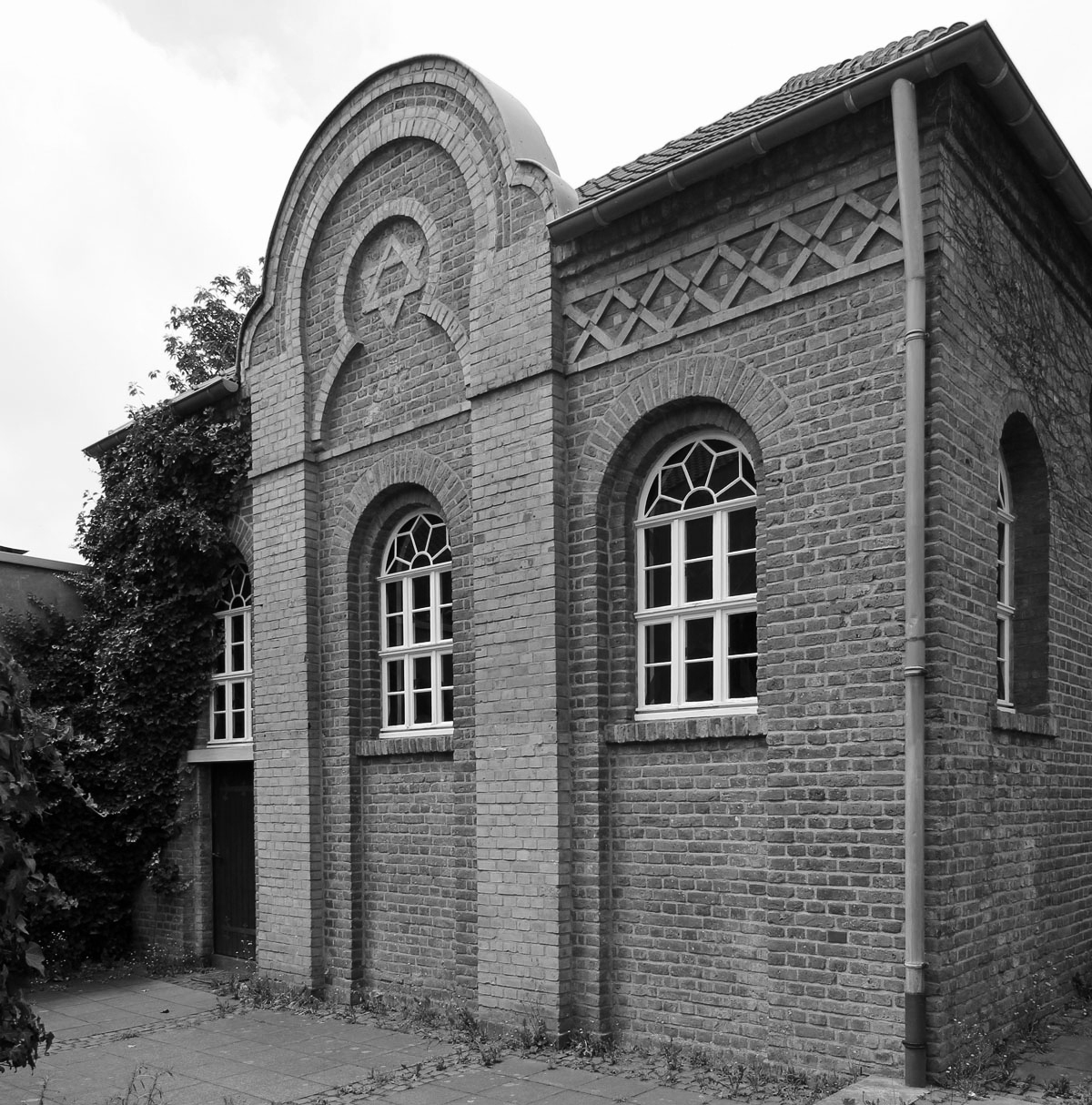
Memory does not become dangerous only when someone openly lies. It becomes dangerous when a story moves sentence by sentence in the more convenient direction. That is exactly what can be observed in the Wikipedia entry on the synagogue in Stommeln: a complex historical situation gradually becomes a more digestible local story. First the purchase is said to have been “feigned,” then it is “arranged”; a storage space becomes a “stockroom”; and a decades-long postwar gap is almost casually turned into restitution. No single sentence by itself explains the problem, but together they form a dramaturgy that soothes where history ought to unsettle.
At first there was still a relatively brief, factual account. In essence it said: the building was sold in 1937, and when SA men wanted to set it on fire in November 1938, the owner declared that it was no longer a synagogue. In this way the building survived the pogrom.

Then, on December 15, 2024, the first decisive shift occurred. The user CSschauff did not rewrite the whole section, but merely added a short block of sentences. It read:
“The Stommeln community was very close-knit and the purchase was meant to be feigned in order to protect the synagogue from demolition by the SA. After the war it was returned.”
That addition looked small. In fact it changed the whole meaning. Suddenly there was no longer only a sale and a later rescue of the building on site, but a new narrative: a closely connected community, a consciously staged purchase, a plan of protection, and later restitution. A historical process became a morally coherent plotline.
Even more revealing is CSschauff’s edit comment. It says:
“I was in the synagogue in 2008 as part of the Schauff family gathering, and the story was told to us in a very moving ceremony. It was cousins of my grandfather, who fled the Nazis to Brazil, who staged the purchase and thus saved the synagogue. In fact, by the time the SA arrived, it was already being used to store his stock.”
This is where the problem becomes fully visible. A “very moving ceremony,” a family narrative, an emotionally powerful transmission of memory: all of that has its place. But it is not automatically a reliable encyclopedic source. Even so, the shift begins here.
How oral transmission becomes a seemingly established historical fact
Changes like this do not arrive as a major ideological attack. They arrive as two sentences, then a rephrasing, then an inserted detail.
The next step followed on February 11, 2025. The user M Huhn did not remove the problematic narrative, but built it more deeply into the running text. It now read:
“In May 1937, the Jewish community of Cologne, as legal successor, sold the synagogue building to the neighboring farmer, who used it as a shed. The sale to him was arranged in order to save the synagogue. The Star of David on the facade was covered with mortar, and the buyer undertook not to use the building as a livestock stable out of respect for its sacred past.”
“When SA men wanted to set the building on fire on November 10, 1938, the owner pointed out that the building, now in his possession, was no longer a synagogue. … The Stommeln community was very close-knit … the synagogue had been filled in time as a ‘stockroom.’ In this way he saved the building from SA vandalism and demolition. After the war the building was returned to the Jewish community.”
At that point, a retrospectively appended addition had become a continuous story. “Was meant to be feigned” now became “was arranged.” Oral transmission became a seemingly fixed historical process. And with the word “stockroom,” the narrative gained an additional vivid detail that made it more plausible and more rounded as storytelling.
This is precisely where it becomes delicate in terms of memory politics. The problem is not that a local story speaks of courage and presence of mind. The problem is that it smooths out the reality of National Socialism. The violence of pogrom night appears almost only as an obstacle overcome by clever action. The dispossession of the Jewish community disappears behind a rescue maneuver. And the sentence “After the war the building was returned to the Jewish community” creates the impression of swift restitution, where in fact there was a long postwar gap.
What matters is this: such changes do not come as a grand ideological intervention. They come in the form of two sentences. Then a reformulation. Then an inserted detail. And suddenly the section no longer reads like a historical reconstruction, but like a locally transmitted legend with a happy ending.
Why the correction was necessary
Less beautifully told. Historically cleaner.
That is exactly why our correction was necessary. In the later revised version, the section was returned to verifiable information: no more services since around 1930; dissolution of the Jewish community in Stommeln and its incorporation into the Cologne synagogue community; sale on May 14, 1937 to Anton Pütz; the contract clause excluding livestock stables; the covered Star of David; an additional entrance; and on the night of November 9 to 10, 1938, the confrontation with an SA command coming from Pulheim, accompanied by Hitler Youth members and equipped with gasoline canisters. This is less beautifully told. But it is historically cleaner.
The synagogue in Stommeln survived as a building. Jewish life in Stommeln did not. A comforting rescue saga shifts attention away from persecution, dissolution, and loss.
As an initiative, we therefore worked not only on site, but also on Wikipedia. We created or expanded key entries on Jewish history in Stommeln: the Jewish community, the Jewish cemetery, and the synagogue, in German, English, and Hebrew. Our aim was to provide reliable, low-threshold access to basic information.
And sometimes the distortion begins with a single sentence.
Wikipedia activities of the initiative
🇮🇱 Hebrew: הקהילה היהודית של שטומלן | בית הכנסת שטומלן | בית העלמין היהודי (שטומלן)
🇬🇧 English: Jewish Community of Stommeln | Stommeln Synagogue | Jewish cemetery (Stommeln)
🇩🇪 German: Jüdische Gemeinde Stommeln | Synagoge (Stommeln) | Jüdischer Friedhof (Stommeln)